SOPO.
Poker App UI.
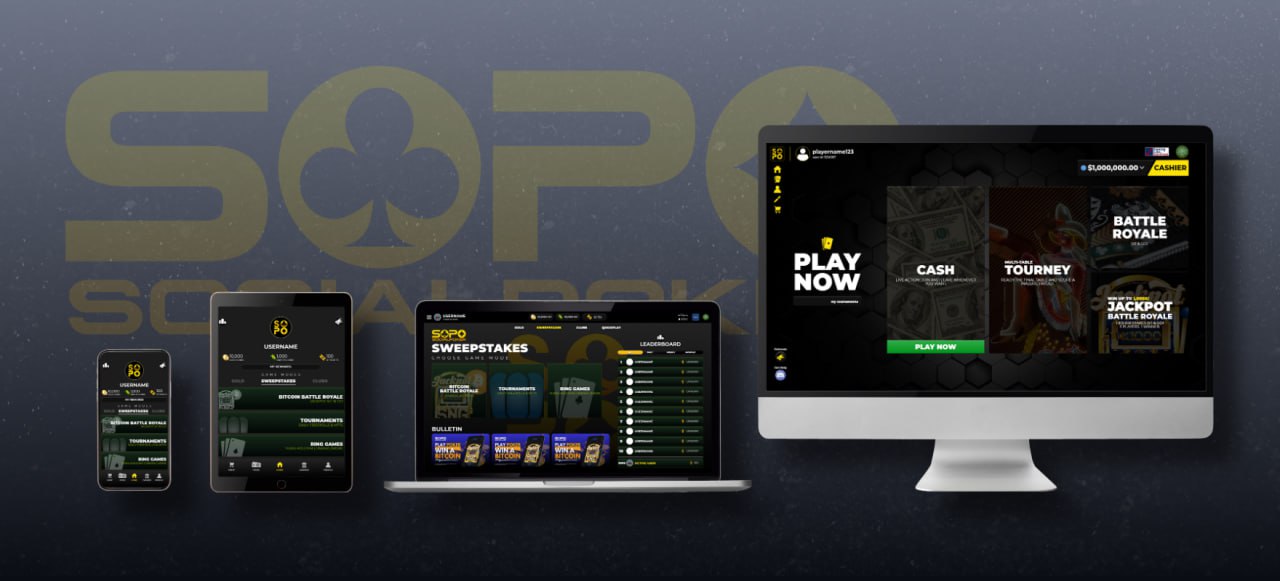
For seven years I was the senior designer and design lead at SOPO, the first and still only mobile poker app on the App Store to offer real-money-value play through sweepstakes gaming law. I owned the product's design direction and the system every screen was built from. What started as a basic mobile app evolved through yearly visual and technical overhauls into a cross-platform experience spanning five platforms: iOS, Android, web, desktop, and the Solana Seeker mobile device.
I led the design across both SOPO (the U.S. sweepstakes product) and SOPO Pro (the international crypto-wallet product), from research and wireframes through high-fidelity mockups, interaction design, motion graphics, and developer handoff. The design system I built was the foundation engineers implemented UI against, so the language stayed consistent whoever was shipping a screen. I worked on a biweekly cycle driven by community feedback and internal testing.
I introduced a gaming-inspired aesthetic drawn from Call of Duty, Fortnite, and Destiny, built complete gamification systems, and created loading animations that turned a technical pain point into a moment of delight. The app reached a 4.8-star App Store rating and 67,000+ registered users.
BUILT
DIFFERENT.
SOPO had something no competitor did: its own poker engine. Every other product in the category white-labels one of about five engines and competes on a reskin, new palette, new fonts, same machinery underneath. SOPO owned the machinery. That was the opportunity, and it defined the design problem. The job was never to make poker look nicer. It was to use structural freedom nobody else had to build the progression, reward, and engagement systems a gaming-native audience expects, across five platforms that shared almost nothing.
- Engagement stopped at the card table.The core game worked, but there was no progression, no reason to return between sessions, none of the systems that turn a poker app into a daily habit.
- Loading transitions stuttered.Worst on the location checks required for sweepstakes-eligible states, the app caught at the exact moment a user was waiting to play.
- Five platforms, five disconnected experiences.Mobile, tablet, desktop, web, and Solana Seeker felt like different apps built by different teams.
- No design system.No component library, no shared language, every screen built as a one-off. Nothing to scale seven years of iteration on.
RAISING THE
Stakes.
Seven years of continuous evolution, in three phases. Each one built on the engine underneath, and each one raised what the product could be.
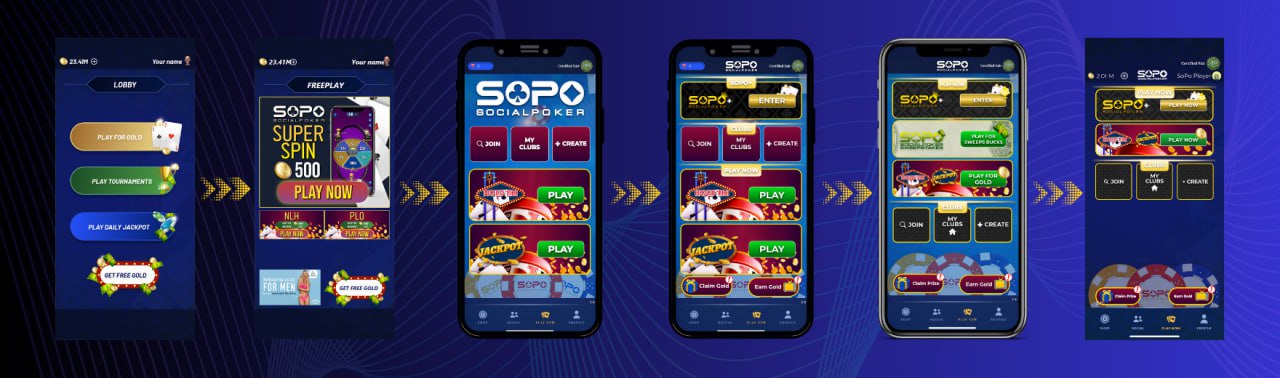
Built the visual language and the foundation everything else would stand on: color system, typography scale, and a reusable component library, plus the core poker experience itself, chip stacks, card animations, table layout, tuned to stay responsive on slower devices.
This phase was about trust through consistency. Every screen, every state, every edge case resolved before moving forward, because none of what came later would hold without it.
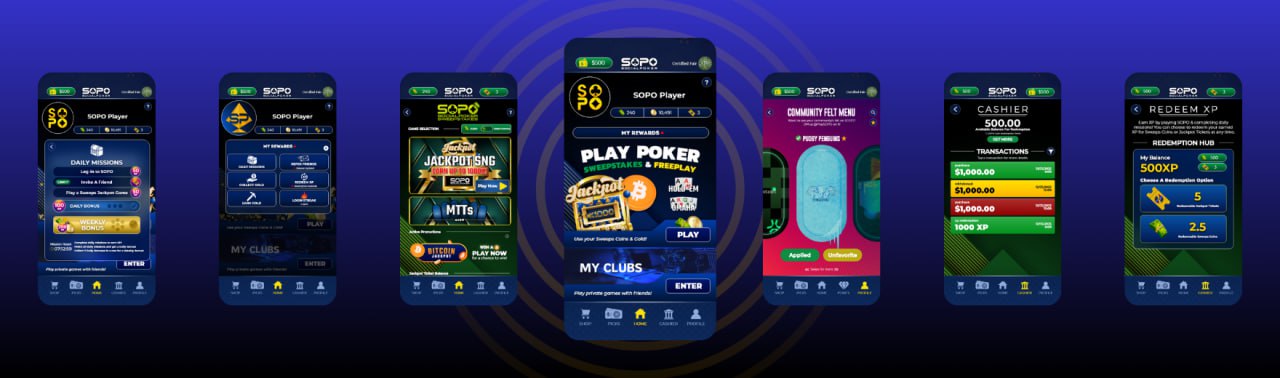
This is where owning the engine started to matter. Every competitor in the category white-labels one of about five engines, which means they can reskin but they cannot vertically integrate anything new. SOPO could. Coming at poker as a designer rather than a purist, I studied what made gaming-native card products like MTG Arena and Gwent compulsive, then built those mechanics directly into the engine.
- XP progression with visible level-up rewards
- Daily missions refreshing every 24 hours
- Login streaks with escalating incentives
- Weekly and all-time leaderboards
- Custom table felts, so every private community could brand its own room
- NFT avatars carrying trait metadata, worn as a flex of rare and valuable traits
- Crypto wallet integration, native to the play experience
The one I am proudest of started as a single unified idea. Watching how Twitch's native predictions feature landed with the exact demographic SOPO was built for, I designed split-screen play, a live poker stream and a playable table in one mobile window, alongside flop-color betting, where a player wagers coins on the majority color of the flop in a hand they are actively playing. The Main Stage extended the idea: an observable, unjoinable table seating famous players that anyone could watch live. Observation shipped. Letting observers wager on a table they were not seated at was in development when I left. None of this was possible for a competitor renting an engine.
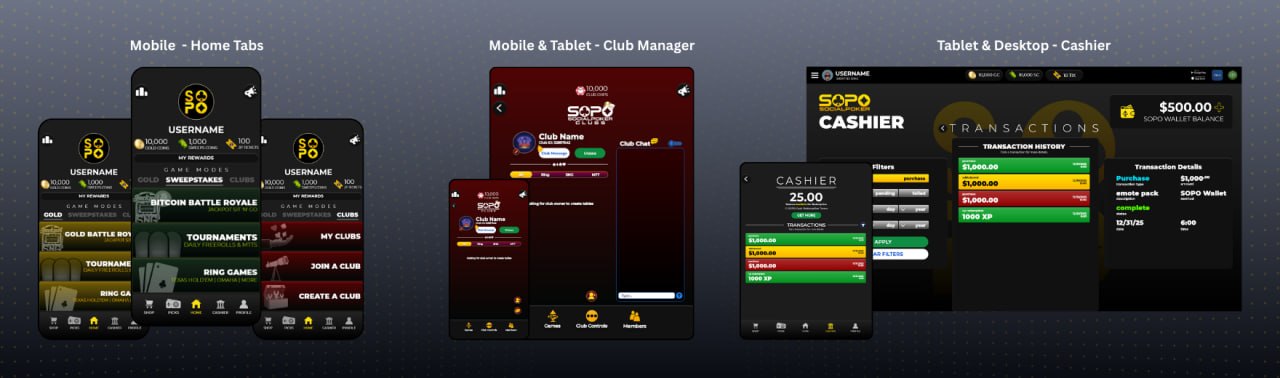
Two things happened in this phase. The product went cross-platform, and it grew up. Ahead of the sweepstakes launch, the visual language matured deliberately: darker palettes, less decoration, more traditional sizing and layout. Early users had said SOPO read as amateur next to the established names, and while the product was anything but, that perception was a real barrier to trust in a market where trust is everything. I took the note seriously and designed for credibility without losing the identity that made it ours.
On platform, each surface was designed to its own strengths instead of forced into one layout:
- Mobile: touch-first, large tap targets, swipe gestures, one-handed play
- Tablet: landscape-first, split-screen live play and viewing
- Desktop: command-center layout, multi-table, keyboard shortcuts
- Web: full-featured browser play with no install friction
- Solana Seeker: blockchain-native with crypto wallet integration
DESIGN IN
Motion.
Leading design meant owning craft end to end, including the app's sound. I scored it myself, sourcing, layering, and mixing every sound effect in these animations, drawing on a background in music production and DJing for the ear for timing and impact.
The loading transition is the one I point to. The app had a real technical constraint: inter-screen loading stuttered, worst on the location checks required before entering sweepstakes-eligible game modes, exactly when a user was waiting to play. Rather than treat it as an engineering wart, I designed around it. The doors-closing-and-opening transition acts as a curtain, covering the stutter completely and turning a moment of dead latency into a signature beat of the product. The user never sees the catch. They see a deliberate flourish.
Turn on sound using the speaker icon on each video.
SEVEN YEARS.
The Numbers.
Seven years of continuous evolution, measured. These are the numbers I stand behind and can walk through in any room.
We did not run betas the way most companies do. We ran them as large-scale tournaments seeded directly into real crypto and online poker communities, then gathered structured feedback from each community at the close. A 2,000-member Discord ran as the always-on feedback loop between waves. Every major evolution was validated against real players in the wild before it shipped, and the retention numbers climbed with each pass.
WHAT SEVEN
Years Taught Me.
NEXT PROJECT.
Screen Park, UX/UI concept for the modern theme park guest.